Once the process is finished,
you will be automatically
redirected to the order confirmation page.

Due to constant currency fluctuation, prices are subject to change with or without notice.
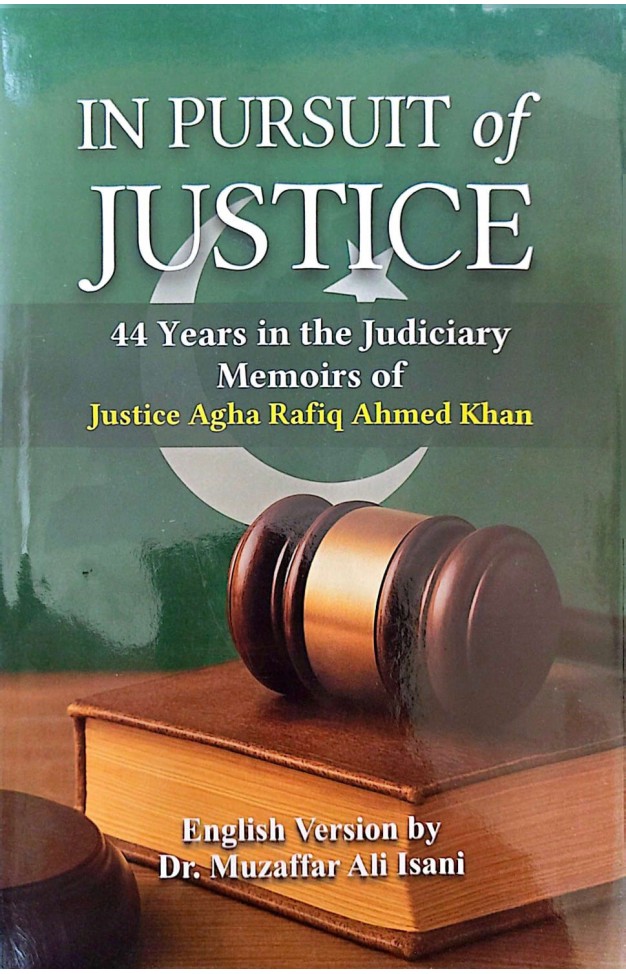
In Pursuit of Justice: 44 Years in the Judiciary is the English translation of Justice Agha Rafiq Ahmed's autobiography, originally written in Urdu. Agha Rafiq's account is not only a personal narrative but also provides a valuable historical perspective on Pakistan's judiciary.
Having served for over four decades in the judicial system, from a civil judge to the Chief Justice of the Federal Shariat Court, Agha Rafiq is uniquely positioned to critique the workings of Pakistan’s justice system. His assertion that the judiciary itself is a breeding ground for ongoing injustices offers a serious critique, although he refrains from criticizing individual judges. He argues that judges, despite their best intentions, are often constrained by the broader systemic and societal environment in which they operate.
Agha Rafiq elaborates on this point with examples from his own career, highlighting how attempts to reform the system often fall on deaf ears. He emphasizes that outdated colonial-era laws and lengthy court procedures obstruct justice, while laws themselves tend to favor the elites at the expense of marginalized groups. In his view, the judiciary functions in a deeply hostile societal environment, where corruption, hypocrisy, and political interference are rampant, making true justice nearly impossible to achieve.
Despite the outward displays of religiosity, Agha Rafiq notes a troubling lack of moral integrity within the system. He shares how witnesses often give false testimony under oath, with one hand placed on a religious text, undermining fair outcomes. Nonetheless, Agha Rafiq remains adamant that society must continue striving to eliminate the most blatant injustices.
In addition to his insights on the legal system, Agha Rafiq's memoirs provide a unique perspective on political decision-making, drawn from his direct experience in bureaucratic roles, including his time as law secretary at both provincial and federal levels, as well as his involvement with Pakistan International Airlines and the Boy Scouts Association. He details how political interests often shape the judiciary's core functions, with the justice system frequently serving political agendas.
Despite these challenging conditions, Agha Rafiq maintained a reputation as a fair and impartial judge, committed to dispensing justice without bias or favoritism. He suggests that if more judges in Pakistan upheld such principles, justice could indeed prevail. Only in a just society can true prosperity be realized. Regrettably, individuals like Agha Rafiq, who embody fairness and integrity, are often unpopular with the very segments of society that would benefit the most from such qualities.
| Publication Date: | 15/01/2026 |
| Number of Pages: | 280 |
| Binding: | Hard Back |
| ISBN: | 9789694075648 |
| Categories: | Non Fiction History |